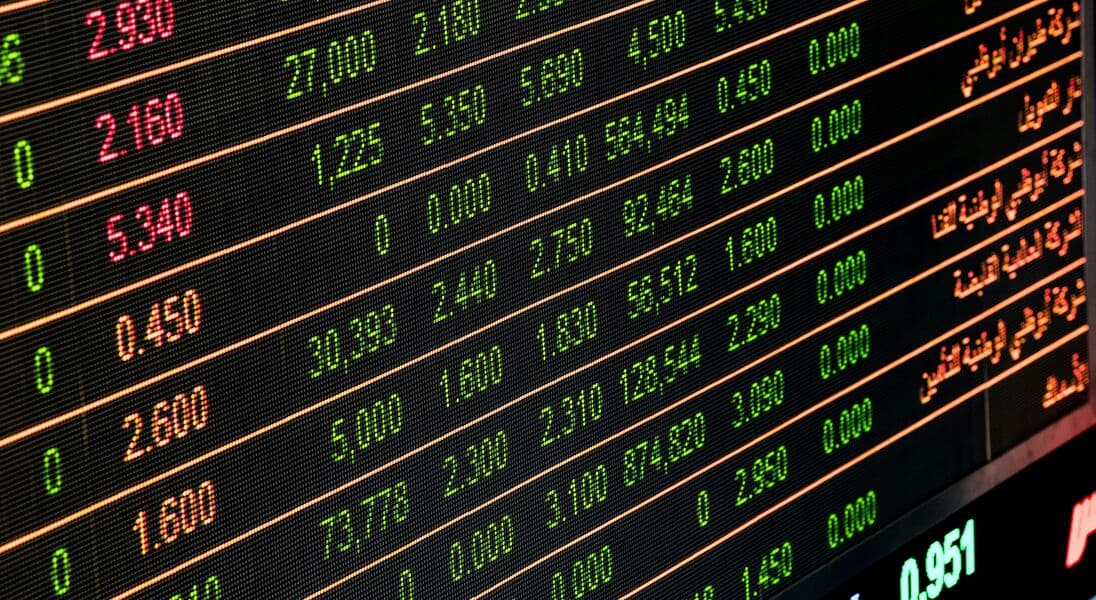
Casablanca Stock Exchange — MASI Flat at -0.01% for the Week as REBAB Jumps 6.0% and Marsa Maroc Drives Trade
The MASI ended the week of October 12-16, 2026 down just 0.01% at 16,997.92 points, with market breadth split between 29 gainers and 24 losers. REBAB led advances with a 6.0% rise, while Marsa Maroc stood out on MAD 11.28 million in turnover amid strategic port-sector news.
|7 min read
The October 12-16, 2026 trading week ended with Casablanca’s benchmark barely moving on paper, but with far more action underneath the surface. The MASI slipped 0.01% to 16,997.92 points, while REBAB Company posted the strongest gain on the market at +6.0% to MAD 93.8 and SODEP-Marsa Maroc drew MAD 11.28 million in turnover, highlighting investor interest in infrastructure-linked names and Morocco’s external trade story.
That near-flat index performance concealed a more nuanced sector rotation between defensives, financials and domestically exposed stocks. With Brent crude at $109.46 a barrel, up 3.3% on Friday and 2.6% over the week, and EUR/MAD rising 2.31% to 10.929, the Morocco stock market had to absorb two opposing forces at once: higher imported energy costs on one side, and some support for exporters or hard-currency-linked revenue streams on the other.
Key figures
- MASI: 16,997.92 points (-0.01% for the week)
- REBAB Company: +6.0% to MAD 93.8
- Wafa Assurance: +3.2% to MAD 4,952
- Marsa Maroc turnover: MAD 11.28 million
- Brent crude: $109.46 (+2.6% for the week)
Market context: a flat MASI index, but not a quiet market
Across the main Casablanca benchmarks, the weekly picture was mixed. The , the , while the index ended at , unchanged on the week. Year to date, the damage remains more visible: the , the , and the gauge is off , underlining that 2026’s correction has not yet been reversed.
Market breadth was healthier than the headline index move suggests. Twenty-nine stocks rose, 24 declined, and 28 were unchanged out of 81 listed names. In other words, the slight dip in the MASI reflected the drag from a handful of heavyweight stocks rather than broad-based selling. Among the notable laggards were BCP, down 0.8%, Bank of Africa, down 1.6%, and Itissalat Al-Maghrib, down 1.1%. That concentration matters in Casablanca: when banks and telecoms soften, the whole index tends to lose momentum.
Turnover data reinforced that reading. Attijariwafa Bank led trading with MAD 14.28 million, followed by Marsa Maroc at MAD 11.28 million, LafargeHolcim Maroc at MAD 9.48 million, Addoha at MAD 7.62 million, and Wafa Assurance at MAD 7.59 million. The fact that two of the five busiest names were outside the usual banking and telecom heavyweights suggests investors spent the week hunting for more specific catalysts in insurance, real estate and port logistics.
The week’s real story: rotation into domestic and port-linked names
The main takeaway from this Casablanca stock market analysis is not the 0.01% decline in the benchmark, but the clear rotation into less crowded domestic stories. REBAB Company surged 6.0%, ahead of Wafa Assurance at +3.2%, Involys at +2.9%, Stroc Industrie at +2.8%, and Alliances at +2.6%. That leaderboard points to a market rewarding stock-specific narratives and catch-up trades rather than making a broad directional bet on the index.
Marsa Maroc deserves particular attention even though the stock ended the week unchanged. According to Infomédiaire and H24info, CMA Terminals finalized the acquisition of a 49% stake in Nador Container Terminal alongside Marsa Maroc. For the market, the significance is not merely corporate ownership. It goes to the heart of Morocco’s logistics build-out, the visibility of future port flows, and the company’s positioning on strategic infrastructure assets. The MAD 11.28 million traded in the stock suggests investors treated the news as a medium-term catalyst even without an immediate price breakout.
That interpretation fits the macro backdrop. Brent at $109.46 raises the energy import bill for a net importer such as Morocco, which can pressure industrial margins and overall sentiment. At the same time, the 2.31% rise in EUR/MAD mechanically boosts the dirham value of some euro-denominated revenue streams, especially in tourism, exports and logistics tied to Europe. The market therefore had to balance cost pressure against external revenue support, which helps explain why the MASI index looked flat while individual names moved more sharply.
Insurance, real estate and energy offered pockets of resilience
Among the clearest gainers, Wafa Assurance rose 3.2% to MAD 4,952 on MAD 7.59 million in turnover. The move came as, according to Medias24, regulator ACAPS launched a new platform for policyholder complaints. While the immediate earnings impact is not quantified, the market may be reading the development as part of a broader modernization of the insurance sector and a gradual improvement in customer-service infrastructure, both relevant for long-term valuation.
Real estate also held firm. Alliances gained 2.6% to MAD 360, while Douja Prom Addoha added 2.0% to MAD 34.99 on MAD 7.62 million in turnover. That resilience extends the renewed interest already seen in Bourse de Casablanca — Addoha s'envole de 8,3% sur 7,38 MDH, l'immobilier relance le MASI. The sector remains sensitive to borrowing costs and domestic demand, but it is also benefiting from a rebound trade after several quarters of depressed valuations.
Energy and mining provided another support layer. Taqa Morocco rose 2.5% to MAD 1,640 as oil prices climbed amid international geopolitical tensions. For a power stock, the market reading is never straightforward: higher crude can increase concern over the country’s energy costs, but it also refocuses attention on supply-security assets and the visibility of contracted operations. In mining, SMI gained 2.5% to MAD 5,760 while gold rose 0.3% to $4,181.4 and silver added 0.9% to $57.37. By contrast, Minière Touissit fell 1.8% to MAD 4,027, showing that firmer precious metals prices were not enough to lift the whole segment.
The drags: sugar, second-tier banks and telecoms capped the upside
On the downside, Cosumar dropped 2.2% to MAD 173 despite a heavy flow of operational news. According to Medias24, L’Economiste and La Vie éco, the group launched its 2026-2027 campaign with a 63,000-hectare sugar crop program and MAD 390 million in agricultural and industrial investment, targeting more than MAD 3 billion in economic spillovers. The stock’s decline suggests the market focused less on the headline ambition and more on execution risk, agricultural costs and the sector’s sensitivity to input prices.
Financials were mixed rather than uniformly weak. CIH rose 2.5% to MAD 307.85, but CFG Bank fell 0.5% to MAD 194, CDM lost 0.7% to MAD 914.4, BCP slipped 0.8%, and Bank of Africa dropped 1.6%. That divergence matters because it shows investors are no longer treating Moroccan banks as a single block. They are differentiating more sharply between growth profiles, balance-sheet quality, pan-African exposure and sensitivity to credit costs in a more volatile external funding environment.
Meanwhile, Itissalat Al-Maghrib fell 1.1% to MAD 90, limiting the benchmark’s ability to rise because of its index weight. In a market where large-cap defensives did not provide support, a few targeted declines were enough to offset gains across nearly 30 stocks.
Outlook: what Casablanca stock exchange today is setting up for next week
For the week ahead, the market will first test whether the turnover seen in Marsa Maroc, Wafa Assurance and Addoha develops into a more durable trend. Investors will also parse the market implications of corporate announcements, including TGCC’s acquisition of 51% of Safettras for MAD 58.6 million, reported by Medias24 and Boursenews, as well as the financing agreement signed by Attijariwafa bank, IFC and Pickalbatros, according to InfoMaroc and Medi1news.
On the macro side, three variables will remain central for any Morocco market recap: whether Brent stays above $109, whether EUR/MAD holds near 10.929, and whether heavyweight banks can stabilize an index still down 9.81% since January. Without making any price call, this week’s message was clear: on the Casablanca stock exchange today, performance is no longer being driven only by the biggest MASI names, but increasingly by stock selection in companies able to turn specific corporate developments into visible trading flows and, potentially, stronger earnings visibility.