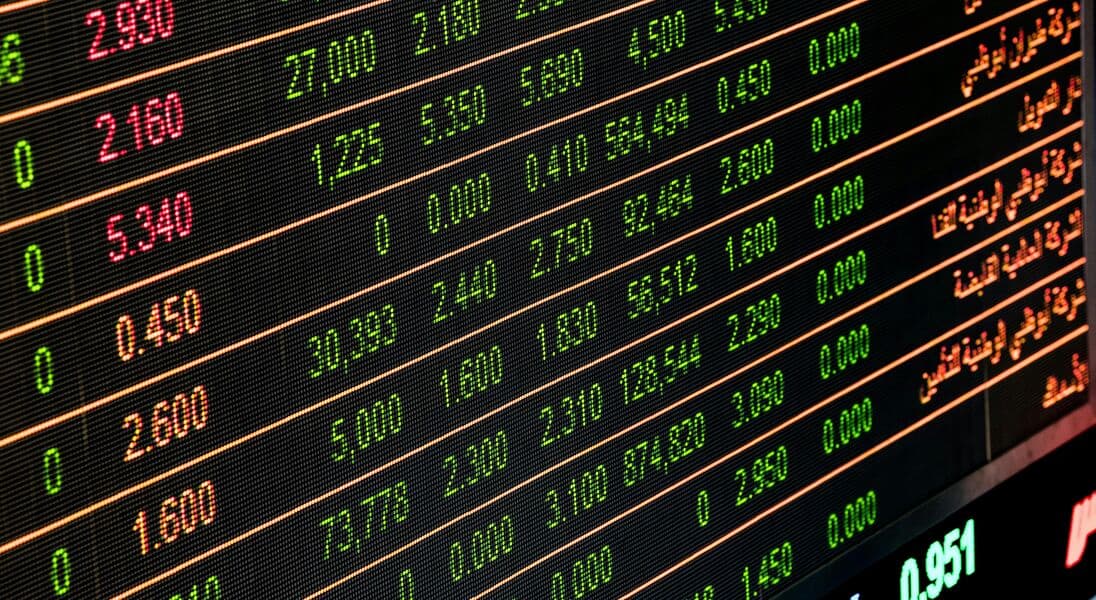
Tunis Stock Exchange — Wifack International Bank Jumps 4.4% as TUNINDEX Slips 0.15%
Wifack International Bank rose 4.4% to 8.08 TND on August 5, 2026, highlighting a rotation into Tunisian financials even as the TUNINDEX fell 0.15%. A stronger dollar at 2.9005 TND and Brent’s 11.8% weekly drop also shaped sector positioning.
|5 min read
A sharp divergence defined the Tunis stock exchange today: WIFACK INT BANK jumped 4.4% to 8.08 TND on Wednesday, August 5, 2026, even as the TUNINDEX index slipped 0.15% to 20,156.33 points. That gap points to a targeted rotation into selected financial names rather than a broad-based market advance, with 23 stocks rising, 32 falling, and 20 unchanged across the session.
The move matters because it came against a mixed tape. The financial services index rose 0.36% on the day and is now up 66.97% year-to-date, comfortably ahead of the TUNINDEX at +49.86% in 2026. In parallel, the macro backdrop remains demanding: the USD/TND climbed 1.74% to 2.9005, the EUR/TND gained 2.08% to 3.3491, and Brent crude held at $79.51 a barrel despite falling 11.8% over the past week. For a net energy importer like Tunisia, those cross-currents matter directly for sector positioning.
- Financial services index: +0.36% on the day, +66.97% YTD
- USD/TND: 2.9005, up 1.74%
- Brent crude: $79.51, but -11.8% on the week
Market context: headline index down, but sector rotation still active
The decline in the benchmark did not reflect a uniform selloff across the Tunisia stock market. The TUNINDEX20 fell 0.30% to 8,876.64 points, yet several cyclical and domestic-demand segments still posted gains. The distribution index rose 0.49%, the consumer services index also added 0.49%, and the insurance index edged up 0.14%. By contrast, the banking index slipped 0.19%, showing that strength in a handful of financial stocks did not lift the entire banking complex.
That distinction is important after such a strong 2026 run. Year-to-date, the banking index is up 57.67%, the financial companies index has gained 58.12%, the insurance index is up 56.7%, and the TUNINDEX20 has advanced 48.56%. After moves of that magnitude, investors typically become more selective. That was visible on August 5, with profit-taking in BIAT, down 1.0% to 167.0 TND, and STAR, down 1.1% to 91.0 TND, while money rotated into Wifack, ATB at +1.8% to 3.9 TND, and CIL at +2.1% to 40.44 TND.
Why Wifack International Bank outperformed by 4.4%
Wifack’s 4.4% rise looks first and foremost like an internal rotation within Tunis-listed financials. Over recent weeks, larger and more liquid banking names have captured much of the sector’s momentum. Wednesday’s move suggests part of the market is now extending that trade into second-line financial stocks with greater sensitivity to incremental buying flows. The fact that Wifack outpaced the financial services index at +0.36% while the banking index itself fell 0.19% underlines that this was a stock-specific relative-strength move, not just a passive sector lift.
Macro conditions help explain why that rotation is happening. Tunisia’s stronger dollar at 2.9005 TND and stronger euro at 3.3491 TND increase pressure on import-dependent companies, especially industrial names that rely on foreign inputs. That helps explain why the industrials index fell 0.58% on the day, while SOTUVER lost 2.0% to 26.95 TND and SOTEMAIL dropped 4.3% to 1.99 TND. Financial stocks, by comparison, can attract flows when investors want exposure to businesses that are less directly tied to raw-material imports and foreign-currency procurement.
Brent’s 11.8% weekly decline adds a second layer. Tunisia is a net energy importer, so lower oil prices can, over time, ease the import bill, improve the trade balance, and reduce pressure on subsidy spending. That is one reason oil matters so much for local equities, as Tunisian macro watchers and IMF-related discussions regularly highlight. But the market is not treating the oil move as a simple positive. Brent still sits near $79.51, and global headlines warning that simultaneous geopolitical and commodity shocks could push oil back toward $120 are keeping a risk premium in place. In that setting, financials remain a relative safe harbor within the local market, even on a day when the benchmark index slips.
CMF filings, STAR’s announcement, and other session signals
On the regulatory front, the CMF published updates dated August 4, 2026 on SICAV AVENIR at 30/06/2026 and SICAV L’EPARGNANT at 30/06/2026, while a press release from STAR was also disclosed. Even so, STAR ended the session down 1.1%, suggesting that regulatory communication alone was not enough to offset broader sector rotation. SPDIT - SICAF, another stock with an announcement in focus, gained 1.2% to 15.59 TND, a modest but consistent move in line with continued appetite for financial vehicles.
Elsewhere, UBCI posted the day’s top gain at +4.5% to 41.71 TND, though it is better read as part of the same broader financial rotation already seen in recent sessions, including Bourse de Tunis — Les financières mènent avec +0,90%, STB et UBCI s'envolent de 4,5%. TAWASOL GP HOLDING rose 3.8% to 0.82 TND, SOMOCER added 3.3% to 0.62 TND, and TUNISAIR climbed 3.2% to 0.32 TND. On the downside, BTE (ADP) fell 4.5% to 7.64 TND, TUNINVEST-SICAR dropped 4.5% to 43.34 TND, and SANIMED lost 2.4% to 0.41 TND.
Tunisia market recap: what the session really says
The August 5 session reinforces that the TUNINDEX index gain of 49.86% so far in 2026 is no longer being driven by a uniform rise across all listed sectors. Investors are increasingly discriminating between companies that can protect margins in a weaker-currency environment and those that remain exposed to imported-cost inflation. The agro-food and beverages index slipped 0.10% on the day despite being up 38.81% year-to-date, while the basic materials index fell 0.28% despite a 31.23% gain in 2026. That is the signature of a market moving from broad momentum to more selective stock-picking.
Wifack International Bank is benefiting from exactly that phase. The stock did not rise because the whole market was strong; it rose while the benchmark was down. For readers following the Tunis stock exchange today, that is often the more useful signal: relative strength on a negative index day can reveal where short-term conviction is building fastest.