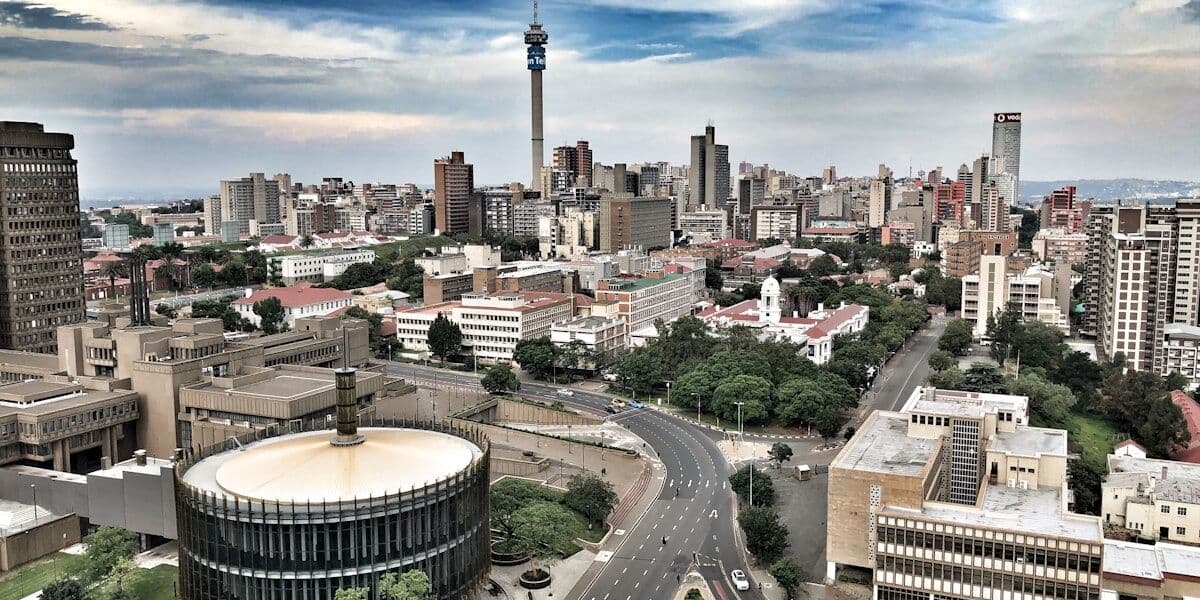
Johannesburg Stock Exchange — JSE Rises 1.01% Despite 31 Decliners as ARM Jumps 4.7% on Gold Tailwind
The JSE rose 1.01% on August 5, 2026, led by miners even as 31 of 53 stocks fell. African Rainbow Minerals climbed 4.7% as gold hit $4,295.5 and a firmer rand at 16.3241 per dollar reshaped the day’s sector moves.
|5 min read
A sharp internal split defined trading on Wednesday, August 5, 2026 in Johannesburg. The JSE All Share rose 1.01% to 115,415.67, while the JSE Top 40 added 1.11% to 107,377.05, even though market breadth stayed negative at 21 gainers, 31 losers, and 1 unchanged stock. That divergence matters: a relatively small group of heavyweight resource names lifted the index, masking weakness across banks, technology, telecoms and parts of the consumer complex.
The day’s leadership was closely tied to global commodity moves. Gold surged 4.9% to $4,295.5/oz, silver gained 3.4% to $62.11/oz, and palladium rose 1.1% to $1,370/oz. At the same time, the rand strengthened, with USD/ZAR at 16.3241, down 1.20% on the day. For anyone tracking the JSE today, that combination created a clear sector rotation: investors leaned into miners with direct or diversified exposure to precious metals, while domestically exposed shares and index heavyweights outside resources lagged.
The Johannesburg stock exchange today looked stronger on the surface than underneath. The best performers were concentrated in resources, with African Rainbow Minerals up 4.7% at 180.12 ZAR, while gold and platinum-group metal names dominated the top of the board. By contrast, financials weakened, with Absa down 1.2%, FirstRand down 1.4%, Standard Bank down 1.9%, Sanlam down 1.5%, and Old Mutual down 2.1%.
Large-cap technology also capped broader upside. Prosus fell 1.5% to 787.39 ZAR, while Naspers dropped 2.0% to 897.00 ZAR. On the JSE, those two names remain critical because of their index weight and their correlation with Tencent. In practical terms, Wednesday’s rise was not a broad-based advance across the South Africa stock market; it was a theme-driven move led by resources, which explains why 31 of 53 tracked shares still closed lower.
JSE mining sector: ARM stood out as investors chased diversified exposure
The core sector story was the JSE mining sector, not only because precious metals rallied, but because investors appeared to favor diversified mining exposure over a narrower single-metal trade. African Rainbow Minerals climbed 4.7% to 180.12 ZAR, making it one of the clearest expressions of the day’s rotation without relying on names already heavily featured in recent coverage.
Why did ARM outperform? First, its diversified commodity exposure matters more when global signals are mixed. Gold jumped 4.9%, but platinum slipped 0.4% to $1,740.7/oz, while Brent crude rose only 0.5% to $79.73/bbl after dropping 11.5% over the week. In a global market shaped by trade barriers, commodity dislocations and volatile pricing signals, as reflected in the macro headlines provided, investors often prefer miners that can absorb diverging cycles across metals rather than depend on one benchmark alone.
Second, the stronger rand had a more nuanced impact than a simple currency headline suggests. In theory, a 1.20% drop in USD/ZAR reduces the rand value of dollar-denominated export revenues. But on Wednesday, the magnitude of the gold rally more than offset that FX headwind for gold-linked miners. That is why mining JSE share prices still rose strongly despite a firmer local currency. The market effectively judged that the positive shock from spot gold was larger than the translation drag from exchange rates.
Trading volumes reinforced that interpretation. Resource counters dominated turnover, with 1.88 billion ZAR traded in Gold Fields, 1.29 billion ZAR in AngloGold Ashanti, 1.13 billion ZAR in Impala Platinum, and 1.12 billion ZAR in Sibanye-Stillwater. Even if those names are not the lead angle here, the volume pattern confirms where capital moved. Afrivestia highlighted a similar dynamic in earlier coverage: Bourse de Johannesburg — Sibanye +5,8% propulse le JSE, le platine efface la chute du Brent.
Gold up, platinum softer, oil unstable: why the mix still favored miners
The key macro point was not just that gold rose, but that precious metals diverged. Gold at $4,295.5/oz and silver at $62.11/oz signaled both safe-haven demand and momentum buying, while platinum at $1,740.7/oz edged down 0.4%. Yet platinum-group metal producers still held up relatively well, suggesting the market was looking beyond the single-day platinum move and also taking support from palladium’s 1.1% gain.
That matters in South Africa because mining groups are often priced off baskets rather than one metal in isolation. When Brent is down 11.5% over a week, energy-linked and chemicals-exposed names can trade very differently from gold miners. That helps explain why Sasol, which released a trading statement for the year ended June 30, 2026, was not the defining driver of the session despite the attention on oil. Investors preferred direct leverage to the gold move rather than exposure to an oil market still clouded by competing narratives, including the Goldman Sachs scenario cited in the macro headlines that sees crude potentially reaching $120/bbl under simultaneous crisis conditions.
Supporting stories: Glencore updates, while banks and consumers limit the rally
Among official announcements on August 5, 2026, Glencore published its 2026 Half-Year Report, while Sabvest Capital issued a trading statement for the six months ended June 30, 2026. The exchange carried 20 official items in total, including ETF listings, debt notices and corporate disclosures. But the news flow did not broaden the rally across sectors.
That was visible in the laggards. MTN fell 2.2%, Telkom dropped 2.6%, Woolworths lost 1.3%, SPAR declined 2.5%, Dis-Chem slid 1.9%, and Life Healthcare fell 2.0%. These moves suggest the market remained selective rather than uniformly risk-on.
Banks also weakened enough to dilute the quality of the index gain. Absa, FirstRand, and Standard Bank all fell between 1.2% and 1.9%, while Capitec lost 1.2% on 916.99 million ZAR in traded value. This is a crucial point for any JSE market recap: when financials are down and both Prosus and Naspers are negative, the JSE all share index can only stay positive if resources deliver a strong enough offset. That is exactly what happened on Wednesday.
Outlook: what to watch after August 5
The next test for the market is whether gold can hold above $4,295/oz and whether the rand remains near 16.32 to the dollar. Investors will also parse the implications of Sasol’s trading statement and Glencore’s half-year report, both released on August 5, 2026, alongside the direction of Brent after its 11.5% weekly slide. If precious metals stay firm while banks and domestic cyclicals continue to soften, the split now visible across the South Africa stock market could remain the defining feature of the near-term tape.